We audit invoices, not decisions
Why the built environment needs a receipt for its technology choices
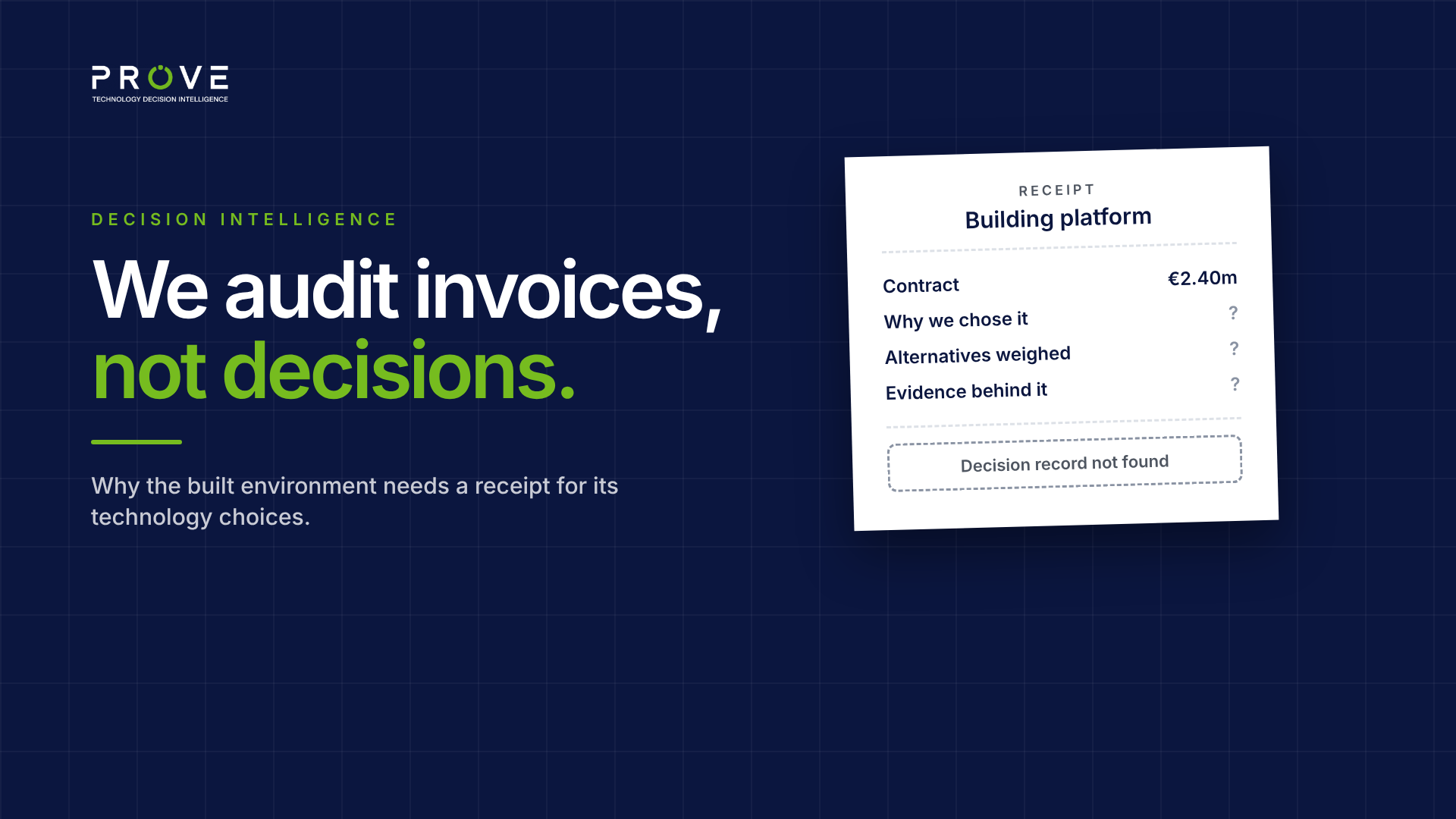
Ask any organisation what it paid for a coffee in March, and finance will find the receipt in minutes. Ask why it chose a €4 million building platform, and you will usually get a story, a slide and the name of someone who has since left.
That gap is the subject of our new white paper, The True Cost of Technology Decisions: Why the Built Environment Needs Decision Intelligence.
I have spent years on both sides of the table, selling building technology and helping organisations buy it. The failures look remarkably similar from either side, and they are rarely about the software alone.
The research is not new. That is the problem.
In a McKinsey and University of Oxford study of more than 5,400 IT projects, large projects ran 45% over budget and delivered 56% less value than predicted. In Gartner Digital Markets' 2025 survey of 3,500 software buyers, 59% regretted at least one purchase made in the previous 18 months.
We have been describing technology failure for well over a decade. We have changed very little about how decisions are made, recorded and remembered.
Information is abundant. Proof is scarce.
Buyers have never had more information. Gartner found that buyers facing high-quality but contradictory information were 153% more likely to settle for a smaller, less ambitious purchase than they had planned. Past a certain point, more research does not reduce risk. It makes decisions defensive.
Decision science points the same way. In McKinsey's study of 1,048 major decisions, the quality of the decision process explained six times more of the variation in outcomes than the depth of analysis.
The scarce resource is not data. It is a disciplined way of deciding what the data actually proves.
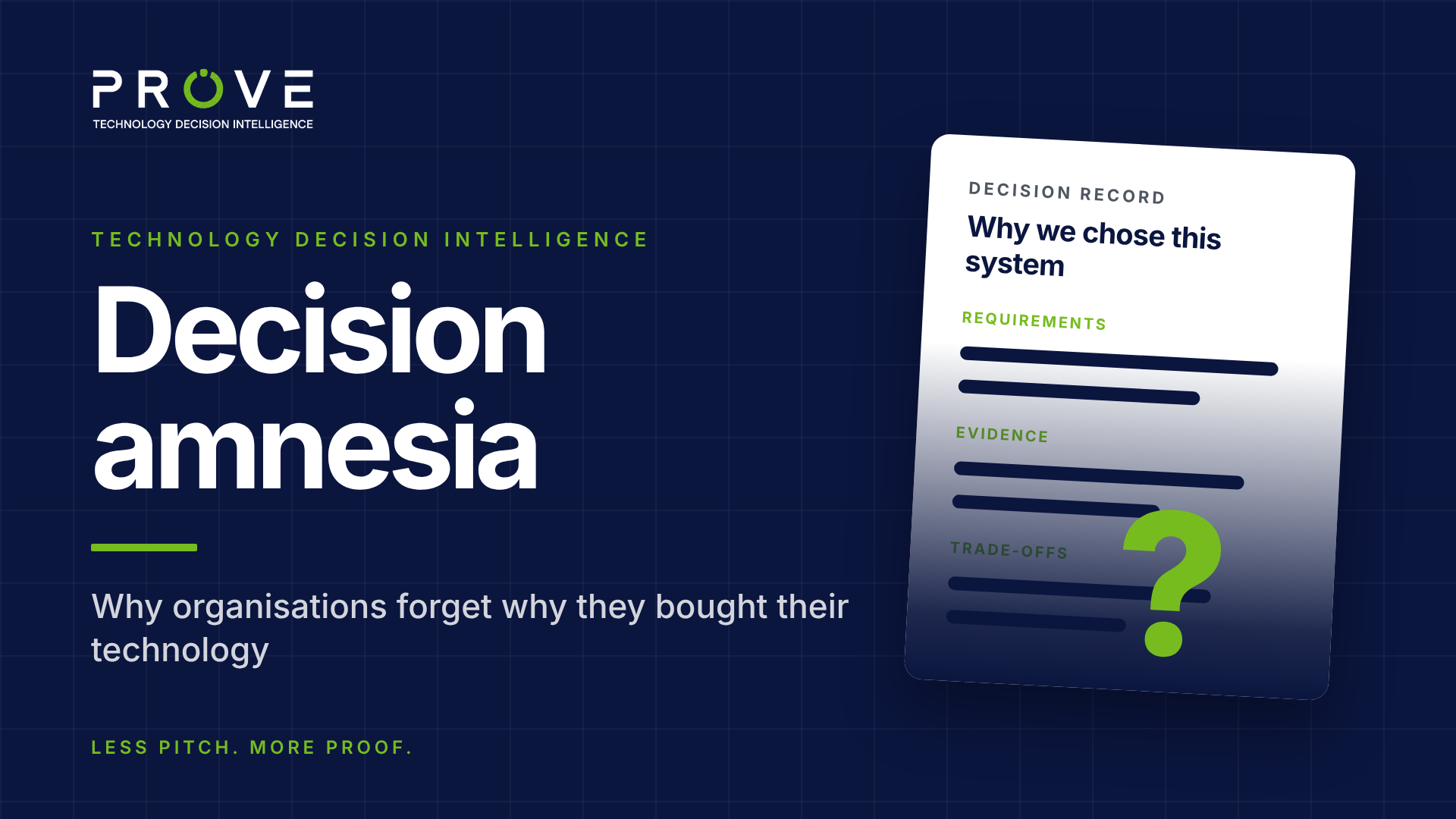
The missing asset: a decision record
Most organisations cannot reconstruct their own technology decisions. Requirements live in one document and scores in another spreadsheet. Approvals are scattered across inboxes. The vendor claims behind it all were never dated, sourced or tested.
In the paper we call the result decision debt: the accumulated cost of technology choices that cannot be explained, tested or revisited. Like technical debt, it is invisible on the day you take it on and expensive every day after. It shows up as integration work nobody budgeted for, licences nobody uses, and a renewal nobody can justify or challenge.
Where the money actually goes
To make this concrete, the paper models a fictional 120-building portfolio selecting a workplace platform over seven years. The contract is €2.40m. Evaluation effort, requirements rework, integration surprises and exit costs add a further €699k, an extra 29%, none of which appears on the contract. Within the contract itself, €340k pays for licences that are never meaningfully used. And €1.08m of business-case value never arrives.
These are illustrative assumptions, not client results. The point is where the cost sits: most of it is set before anyone signs.
We had this model independently reviewed and rebuilt it, so that waste inside the contract and lost benefits are never added to spend. A paper arguing for defensible decisions has to pass its own test.
Regulation is giving technology decisions a memory
In the built environment, "why did we choose this?" is becoming a compliance question as well as a commercial one:
- The recast EU Energy Performance of Buildings Directive requires building automation systems in larger non-residential buildings to interoperate across manufacturers and proprietary technologies.
- The EU Data Act ends cloud switching charges from 12 January 2027.
- Reporting obligations under the Cyber Resilience Act have applied to connected products since 11 September 2026.
A platform chosen today will be judged against rules that tighten during its lifetime.
Five things you can do on your next decision
You do not need any particular software to start:
- Write the decision as one sentence, with a named owner and a deadline.
- Fix your scoring weights before you look at vendors, and log every change.
- Grade each critical claim: is it vendor-stated, source-backed, corroborated or independently verified?
- Keep contradictions on the record instead of averaging them into a score.
- Write expected outcomes as testable statements, and schedule the review at the point of approval.
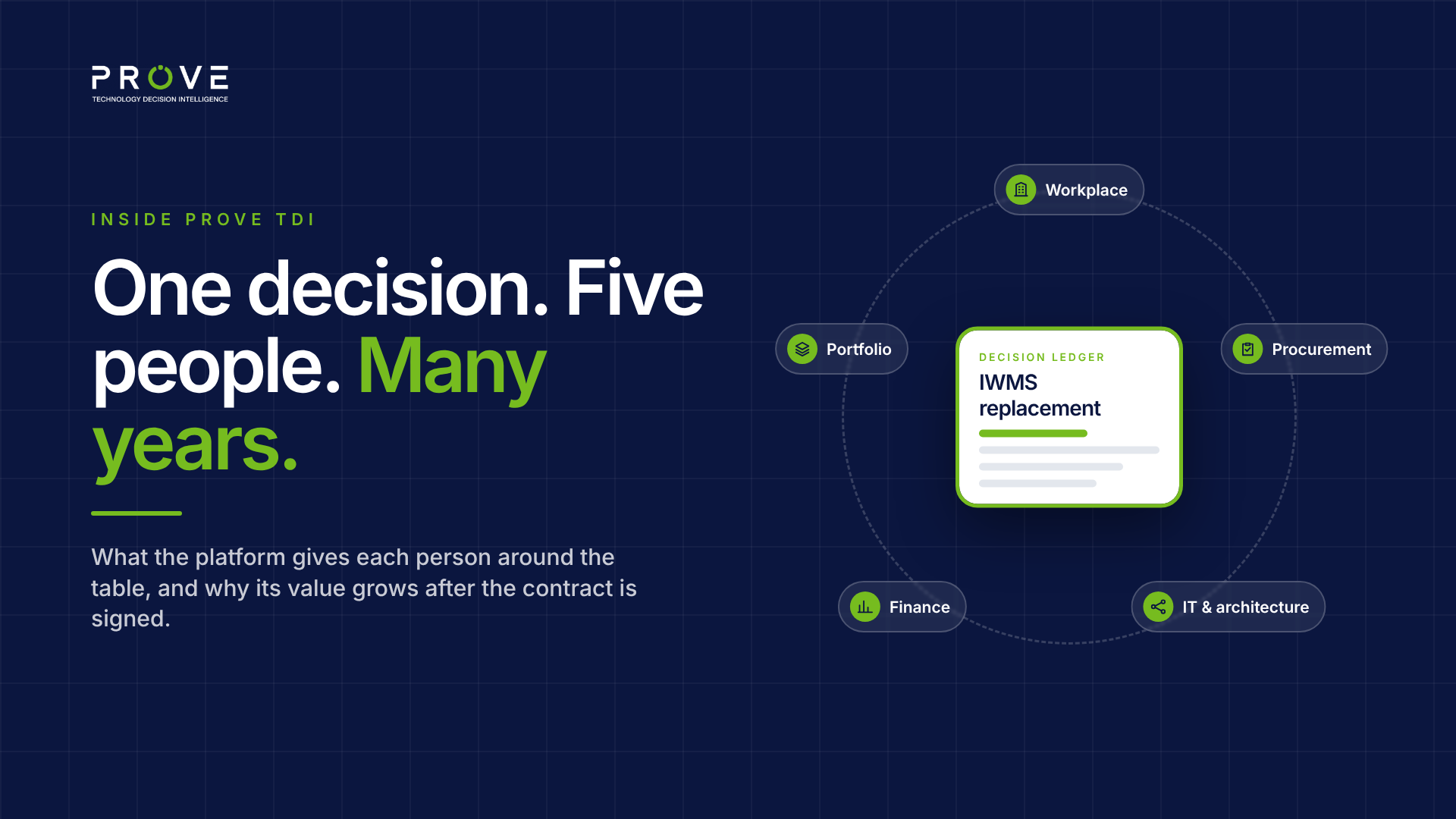
The white paper includes a 30-point checklist that works with or without Prove TDI.
A note on evidence
Every number in the paper carries a label, Source, Internal, Model or View, so readers can weigh it accordingly. Our own case library holds 35,427 documented technology decision failures and risk events across 29 industries. We say plainly that it is internally classified and not independently audited. I would rather show the limits of our evidence than hide them; that is rather the point.
The question that matters now
The question is no longer whether organisations have enough technology information. It is whether they have enough reliable evidence to defend their decisions.
Read the white paper (free, no sign-up): provetdi.com/white-paper
See a governed decision in five minutes, with no account needed: provetdi.com/demo
And a question for you: could you prove today why your organisation chose its current building technology platform?
Originally published on LinkedIn.