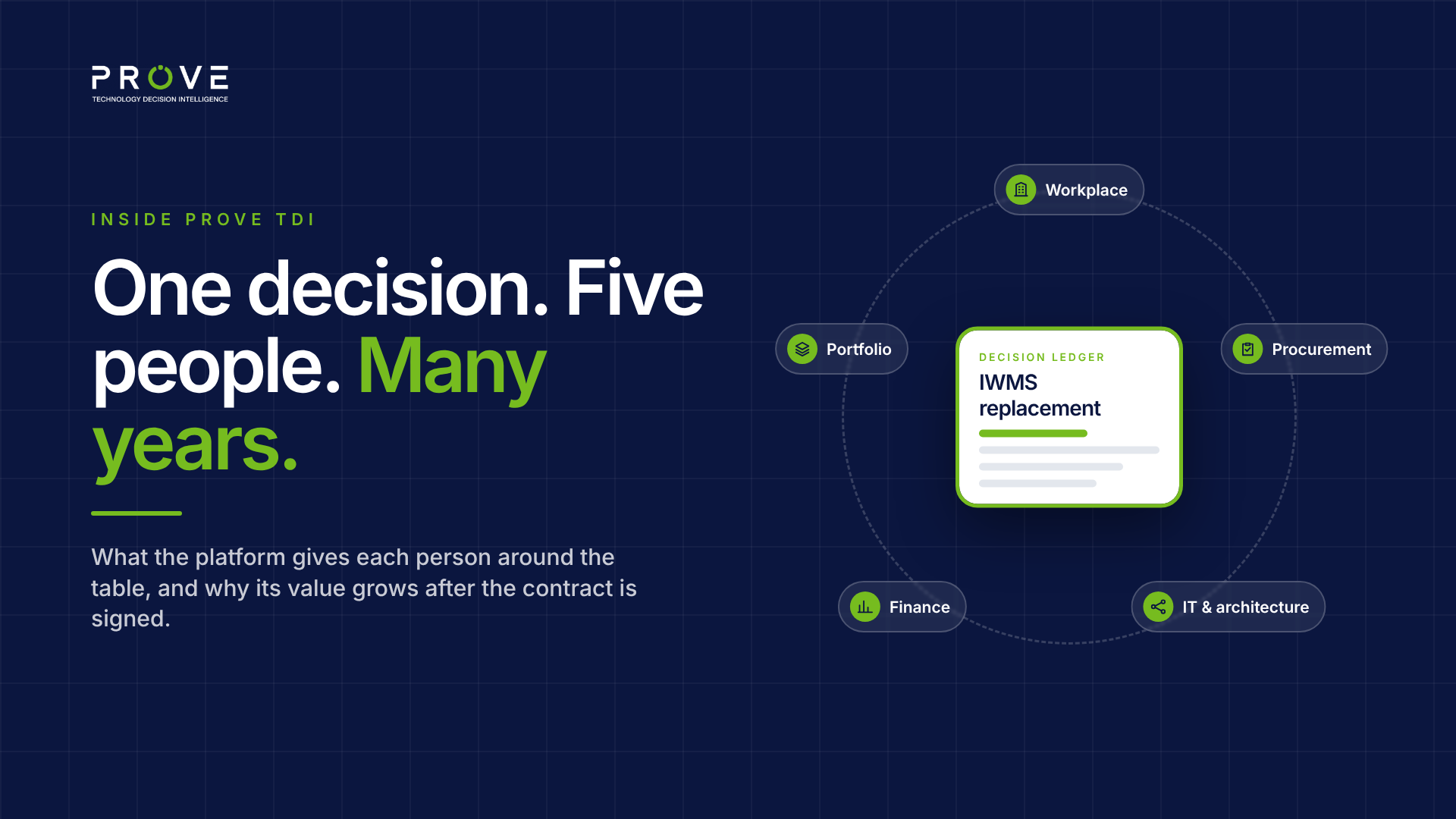
A major technology decision is never made by one person.
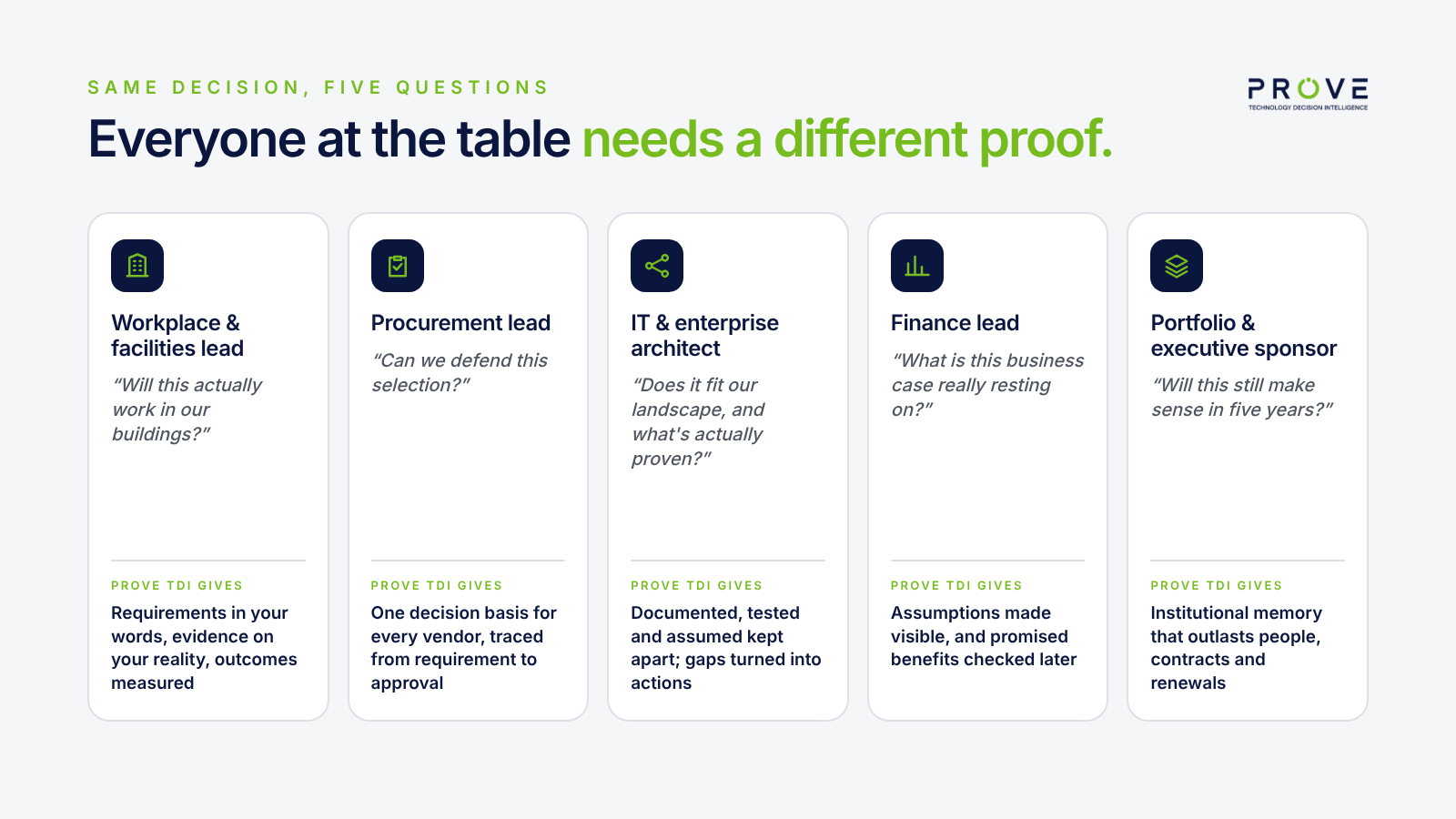
Take an IWMS replacement or a new workplace platform. The workplace lead wants something that works in the buildings and that people will actually use. Procurement wants a process it can defend. IT wants to know whether it fits the landscape. Finance wants to know what the business case really rests on. And someone responsible for the portfolio wants to know whether this decision will still make sense in five years.
Same decision. Five different questions. And usually, five different spreadsheets.
Prove TDI is a Technology Decision Intelligence platform, built to hold all of those questions in one governed record. Not a vendor directory, and not a ranking. A system of record for the decision itself: the requirements, the evidence, the trade-offs, the approvals and, later, the outcomes.
This deep dive looks at the platform through the eyes of the people who use it.
What sits underneath: knowledge, not opinions
Before the personas, a word on what they all draw from.
Prove TDI is built on structured evidence. Every claim carries its context: where it came from, when it was retrieved, what it actually supports, how it was verified, how confident we can be, what contradicts it, and how the source may be used. As of November 2026, the platform holds more than 9,700 active attributable source records and draws on analysis of more than 30,000 real-world case files across workplace technology, PropTech, IWMS and smart buildings.
A simple example shows why that matters. "An API is available" sounds like a yes. A supplier's API guide supports that claim. But it doesn't establish that the API works with your booking-system version. In Prove TDI, that difference stays visible, right next to the claim.
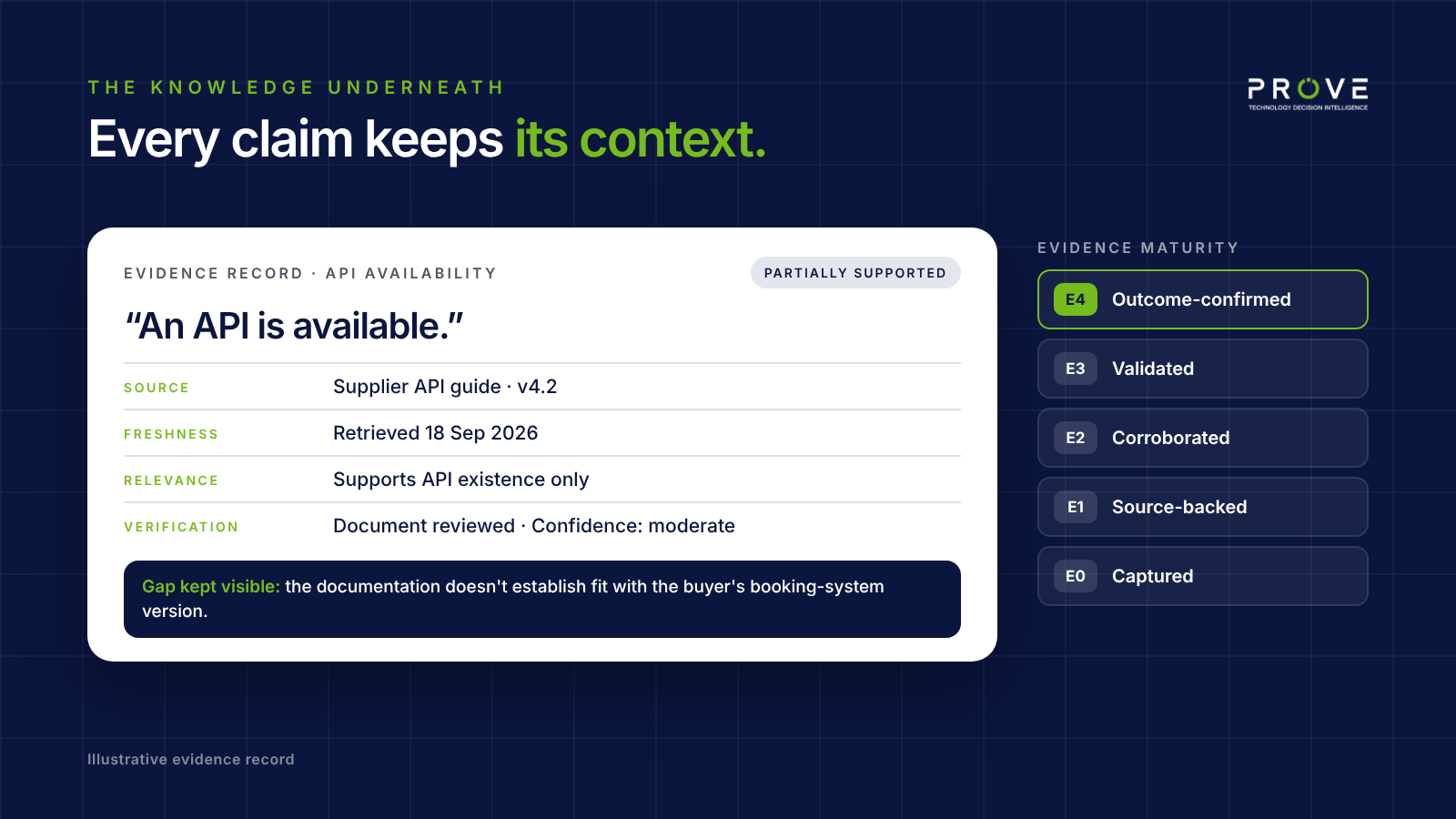
Evidence is graded on the E0–E4 maturity model, from a statement that has simply been captured, to one backed by a source, corroborated independently, validated, and finally confirmed by a real outcome. Confidence follows the strength, recency, independence and consistency of the evidence. Never the quality of the presentation, and never a commercial relationship: vendors can't buy evidence maturity, confidence, ranking or recommendation.
That knowledge layer is the same for everyone. What each person does with it is different.
The workplace lead: "Will this actually work in our buildings?"
The head of workplace or facilities owns the outcome. If the platform doesn't fit how buildings are run, or people don't use it, it's their problem for years.
What they need: requirements written in their own words, not inherited from a vendor's module list. Proof that the product handles their reality: partial floor closures, mixed portfolios, local service models, messy asset data.
What Prove TDI gives them: a decision that starts with the organisation's needs, stakeholders and acceptance criteria, before the market is engaged. Every requirement is connected to the evidence meant to support it, so "supported on our data" never gets confused with "supplier says so". And after go-live, expected results sit next to measured ones, so the workplace lead can show what the decision actually delivered.
The procurement lead: "Can we defend this selection?"
Procurement owns the process. Its job is to make sure the selection is fair, consistent and explainable, to the organisation, to auditors and, sometimes, to a vendor who wasn't chosen.
What they need: the same decision basis for every vendor, criteria that can be traced to real requirements, and a clear record of who decided what, and why.
What Prove TDI gives them: procurement readiness before the RFP goes out. Requirements, evidence thresholds, evaluation logic and decision ownership are tested before the shortlist hardens. The governed criteria carry straight into the RFI or RFP, so nobody starts again from a blank template. Vendor claims stay labelled as vendor claims until they're corroborated. And the final recommendation can be traced back to the original decision context, including the gaps that were still open.
The IT and enterprise architect: "Does it fit our landscape, and what's actually proven?"
IT owns integration, security and the long tail of technical debt. It has heard "yes, we integrate with that" many times before.
What they need: a clear line between documented, tested and assumed. Visibility of security and hosting evidence. And open questions turned into concrete actions, not footnotes.
What Prove TDI gives them: an evidence record that separates what a source establishes from what it doesn't. An API guide proves an API exists; it doesn't prove fit with a specific version. Missing evidence isn't treated as failure, but it isn't papered over either. It becomes a next action, such as a scoped integration test or a request for regional hosting evidence, with an accountable reviewer attached.
The finance lead: "What is this business case really resting on?"
Finance owns the money, and knows that most business cases are more confident than their evidence.
What they need: the assumptions behind the numbers, the cost of the decision process itself, and a way to check later whether the promised benefits arrived.
What Prove TDI gives them: a business case connected to the same evidence and requirements as the selection, so every benefit can be traced to what supports it, and every assumption is visible as an assumption. The cost of the decision, in internal hours, advisory effort and delay, is weighed against the value at risk. And because expected outcomes are recorded at approval, the outcome review compares what was promised with what was measured.
The portfolio and executive sponsor: "Will this still make sense in five years?"
The person accountable for the real-estate or technology portfolio thinks in renewals, standardisation and the next decision after this one. People move on. Contracts come up for renewal. The question "why did we choose this?" always comes back.
What they need: institutional memory that doesn't depend on who's still in the building, and decisions that can be revisited without starting from zero.
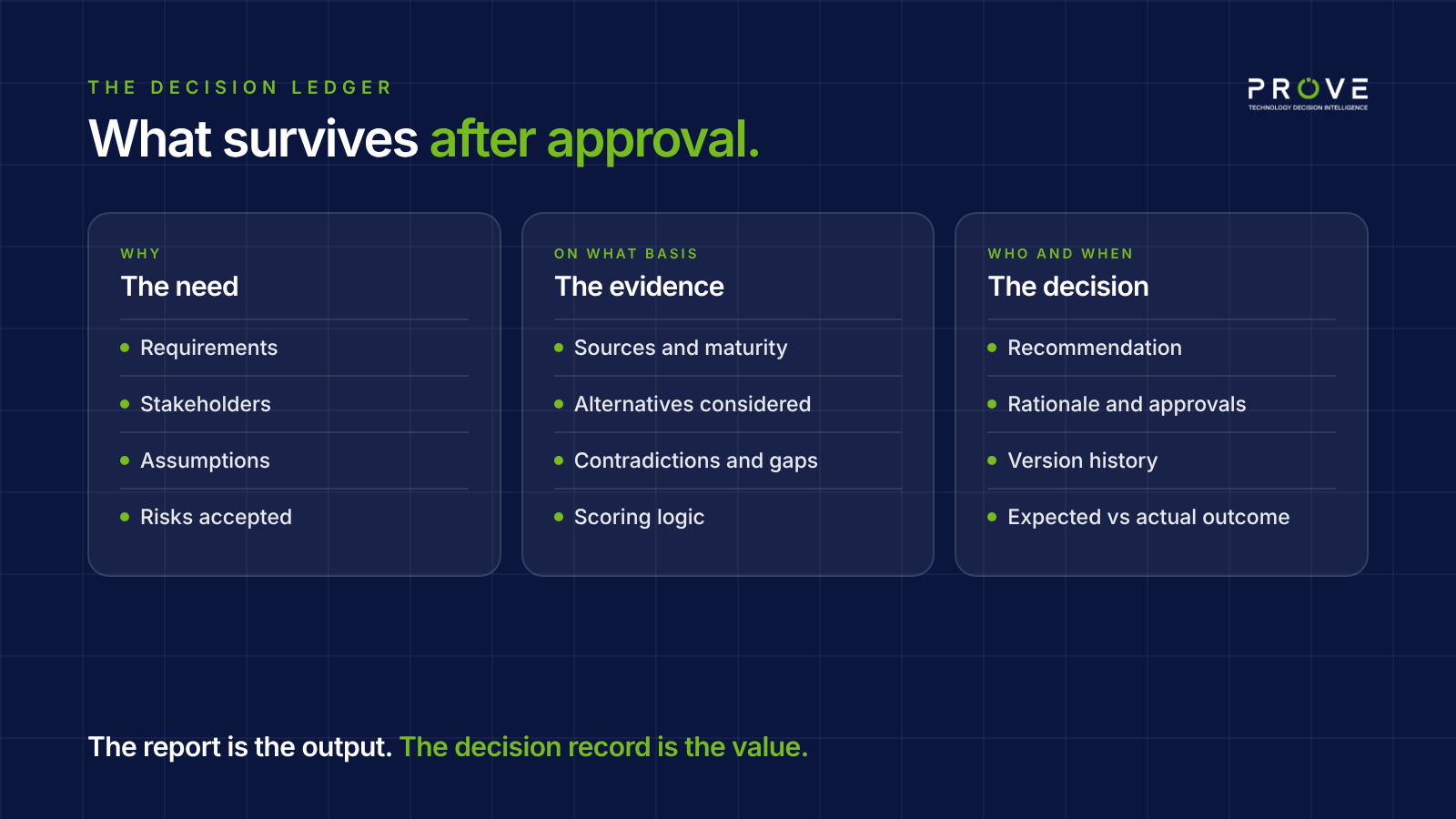
What Prove TDI gives them: the Decision Ledger. It preserves the requirements, stakeholders, evidence, alternatives, assumptions, contradictions, scoring logic, risks, recommendation, approvals, rationale and version of every decision, and connects it to later outcomes. When evidence changes, the earlier decision state stays distinguishable from the new assessment instead of being silently rewritten.
The long game: value that grows after the decision
This is where Prove TDI is most different from a comparison site, or from a one-off advisory project.
A comparison site helps you look at options. An advisory project produces a report. Both stop being useful at signature.
A Decision Ledger becomes more valuable over time.
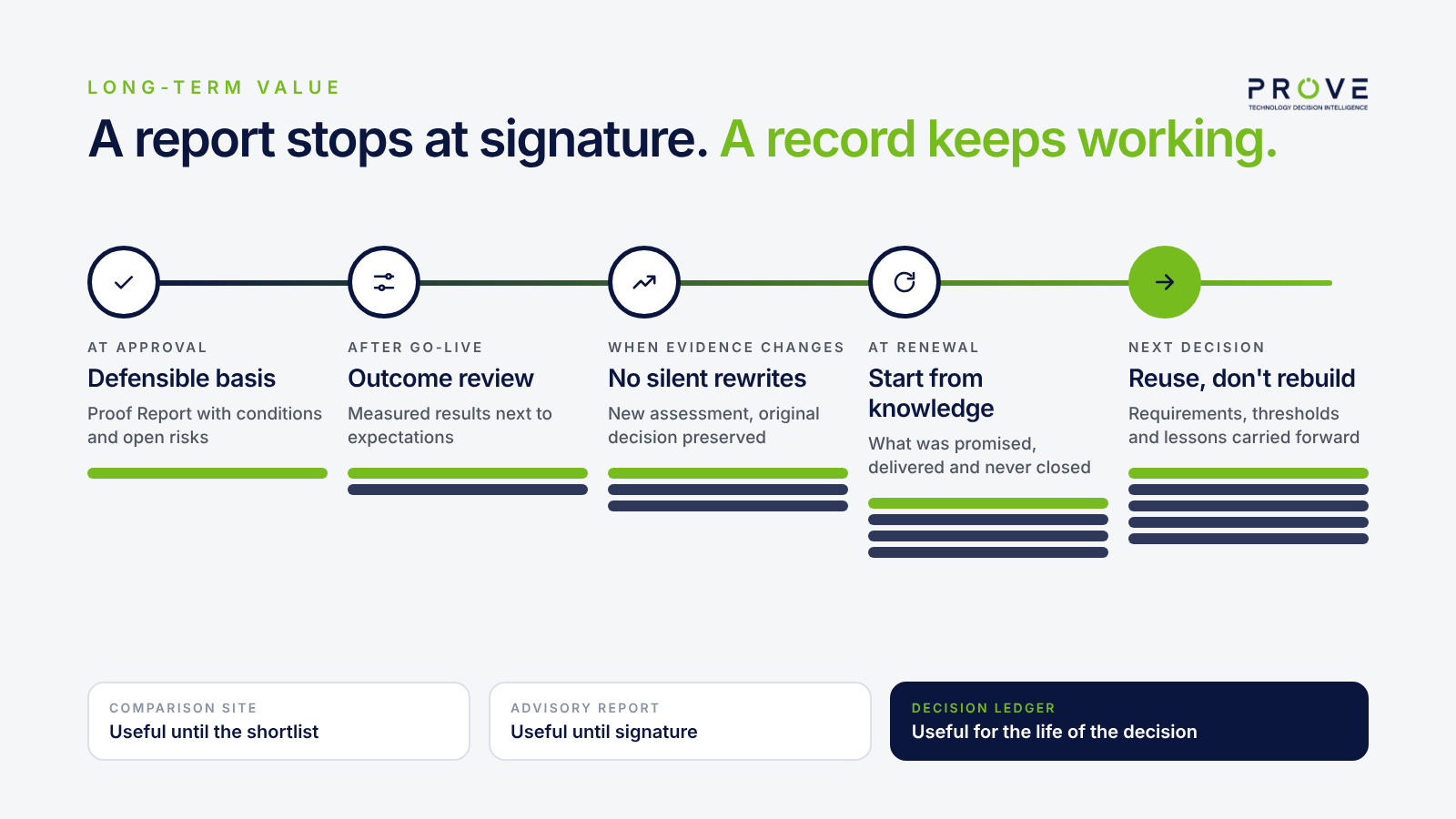
- At approval, it's the defensible basis for the decision, and the Proof Report communicates it, conditions and open risks included.
- After implementation, realised results sit next to the original expectations, without rewriting what was approved.
- At renewal, you start from what you already know: what was promised, what was delivered, what changed in the market, and which gaps never closed.
- At the next decision, the organisation reuses its requirements, evidence thresholds and lessons instead of rebuilding them.
- Under audit or challenge, the record shows who decided what, on which evidence, with which risks accepted.
As we put it: the report is the output. The decision record is the value.
Where AI fits, and where it doesn't
Prove TDI uses AI to do the heavy lifting: structuring evidence, classifying sources, spotting gaps and contradictions, comparing and explaining. That makes deep evidence work fast enough to be practical.
But AI output isn't proof, and it doesn't inherit decision authority. AI-generated analysis isn't promoted to established evidence. Model confidence isn't evidence confidence. And recommendation is never approval: that stays with accountable people.
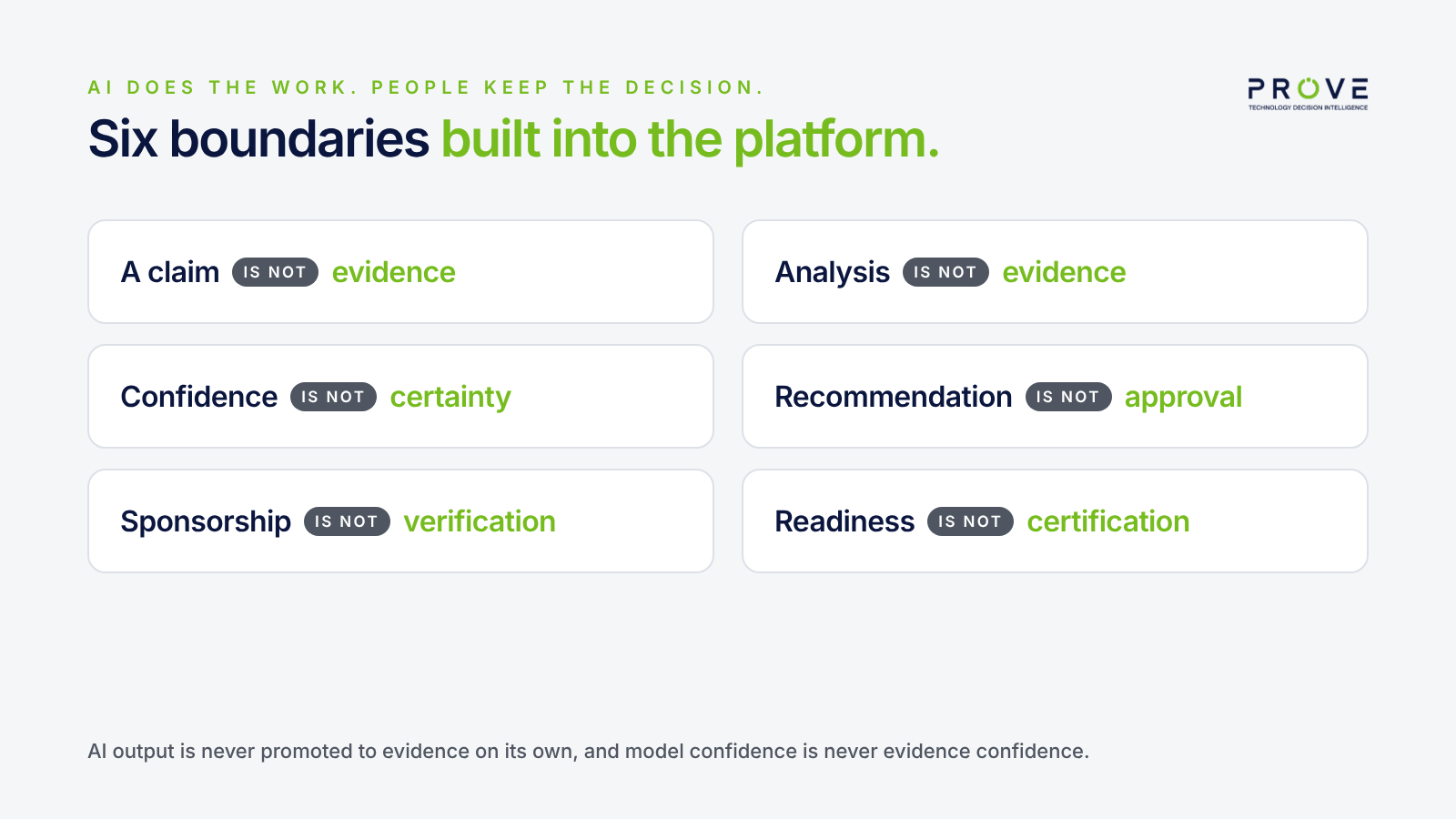
Every persona in this article relies on that boundary. The workplace lead, procurement, IT, finance and the sponsor all need to know that what they're looking at is evidence, not a confident-sounding summary.
One decision, one record, every perspective
Prove TDI doesn't replace the people around the table. It gives them a shared record: the same requirements, the same evidence, the same open questions and the same history, viewed from where each of them sits.
That's what turns a technology decision from a moment into an asset.
You can walk through a fictional enterprise decision in the interactive demo, no account needed, or put one real decision through a seven-day workspace.
Less pitch. More proof.
Explore the platform at provetdi.com.
Originally published on Medium.