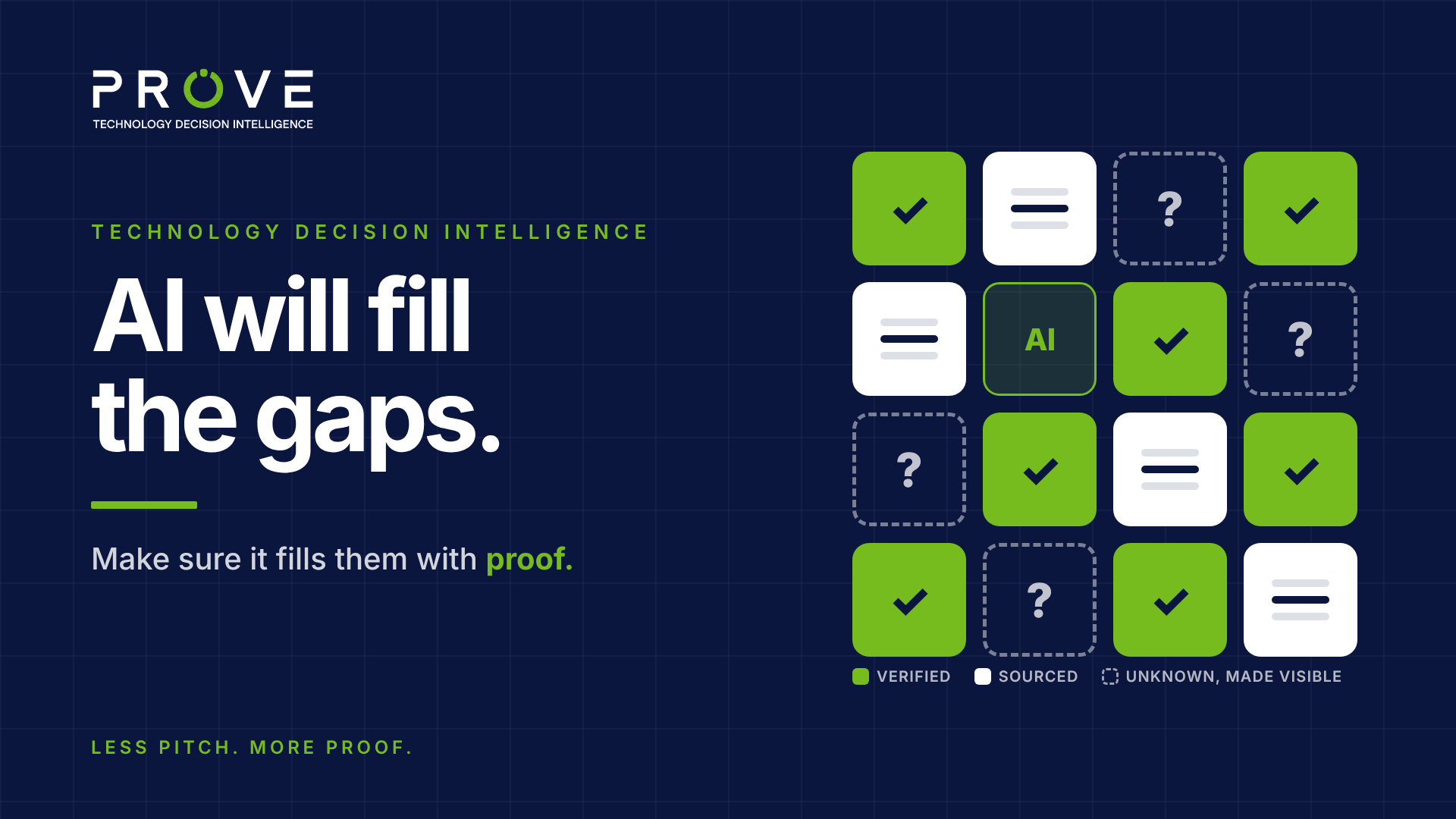
AI will fill the gaps. Make sure it fills them with proof.
Why AI makes confident assumptions about technology, and why the fix isn't a better prompt but a better baseline.
Ask an AI assistant to compare three workplace management platforms and you'll get a polished answer in under a minute. A neat table. Strengths and weaknesses for each. Possibly a recommendation, with reasons.
It reads like the work of a careful analyst, and some of it is probably accurate. The trouble is that you can't tell which parts.
That isn't a flaw in one particular tool. It's how these systems work. When the information is incomplete, AI doesn't stop and say so. It fills the gap with whatever seems most likely. In a technology decision, "most likely" usually means whatever the vendors have said most often.
I've worked on both sides of these decisions: selling enterprise software, and helping organisations evaluate and buy it. AI is about to make both sides faster. Whether it also makes decisions better depends on one thing: what the AI is allowed to assume.
How AI makes assumptions
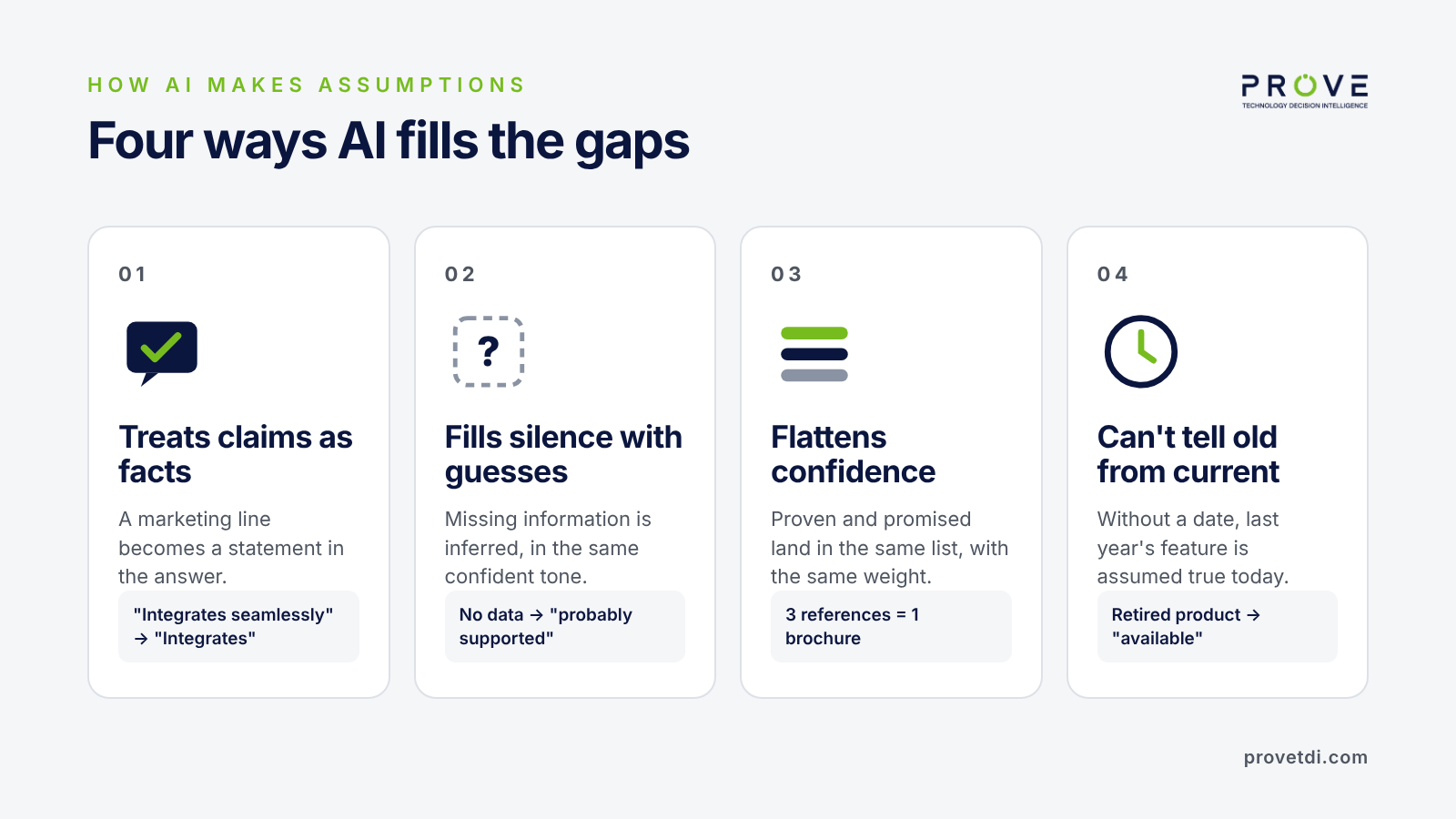
A language model is built to give a plausible, complete answer. It is very good at that. But given partial information, it does four things that matter to anyone buying technology.
1. It treats what it's given as true. If a vendor's website says something like "integrates seamlessly with all major building management systems", that sentence becomes a fact in the answer. The model can't tell it was a marketing line, and nothing in the source tells it otherwise.
2. It fills silence with plausibility. If nothing says whether a product supports EU data residency, the model may infer it from the vendor's size, its market or its competitors. The guess arrives in the same confident tone as everything else, with nothing to mark it as a guess.
3. It flattens confidence. A capability confirmed by three customers and one mentioned once in a brochure end up in the same bullet list, with the same weight. The difference between "proven" and "promised" disappears in the formatting.
4. It can't tell old from current. A feature announced three years ago, a product line since retired, a partnership that ended: unless the data says when something was true, the model has no reason to doubt it is still true today.
None of this is malicious. The tool is doing exactly what it was designed to do. But it means an answer can only be as good as the material it's built on, and only as honest as that material is about what's known and what isn't.
Why technology decisions are especially exposed
Most public information about enterprise software is written by the people selling it: product pages, press releases, webinars, analyst briefings shaped by vendor input, and case studies chosen for their happy endings.
I've written plenty of that material myself, from the vendor side. It isn't dishonest, but it isn't evidence either. It's a pitch. Its job is to present the product at its best, not to tell a buyer where it falls short.
So when AI reads the market, it mostly reads the pitch. Use that in a decision without a baseline and you get the pitch back, reformatted and with an air of neutrality it didn't have before. The best story wins again, only faster and with a more objective-looking table.
The stakes make this worse. A workplace, IWMS or smart-building platform is rarely a one-year decision. It shapes processes, integrations and data for years. A confident wrong assumption at the start can become a very expensive one at go-live, or at the first renewal, when someone asks why the system doesn't do what everyone thought it did.
Why a better prompt won't fix it
The instinctive response is to write a better prompt. "Only use verified sources." "Flag anything you're unsure about." "Don't make assumptions."
Those instructions help a little, but they ask the model to do something it can't do on its own. It can't verify a source it has no way to check. It can't flag uncertainty that isn't recorded anywhere. And it can't avoid assumptions when the material it's given is mostly assumptions dressed as facts.
A prompt tells AI how to behave. A baseline tells it what is true, what is claimed and what is unknown. Only the second one changes what the AI can conclude.
Put differently: for a technology decision, the real prompt isn't the sentence you type. It's the evidence you hand over with it.
Same question, two answers
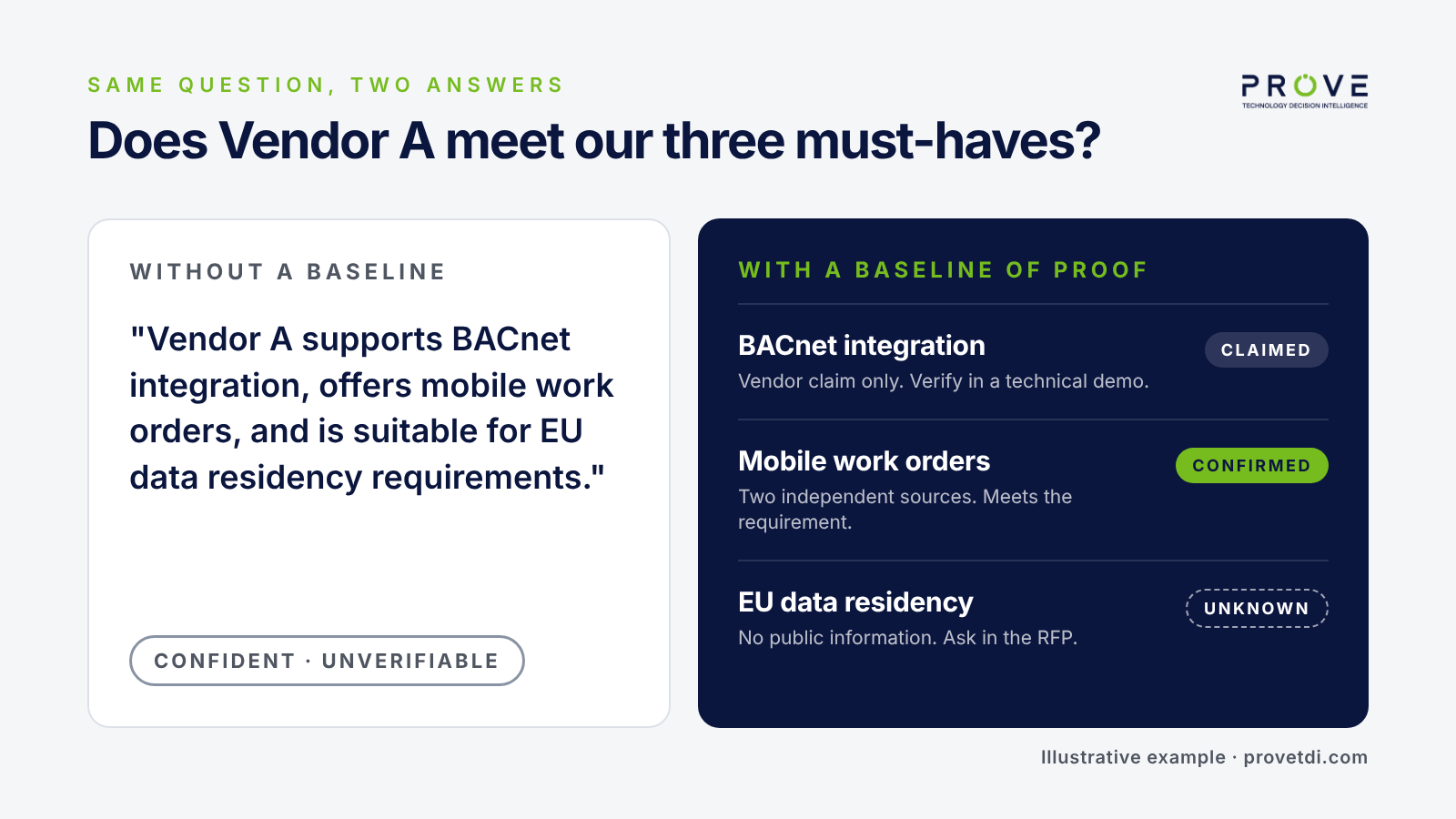
Take one simple question about a fictional workplace platform: does it meet our three must-have requirements?
Without a baseline, a typical AI answer looks like this:
Vendor A supports BACnet integration, offers mobile work orders, and is suitable for organisations with EU data residency requirements.
Clear, confident and unverifiable. Here is the same question, answered against a baseline of attributed evidence:
BACnet integration: claimed by the vendor, no independent source yet. Verify in a technical demo.
Mobile work orders: confirmed by two independent sources. Meets the requirement.
EU data residency: no public information. Unknown. Ask in the RFP.
The second answer is less impressive to read and far more useful to act on. It tells you where you stand, what you still need to check, and what you can't assume. It also gives you three ready-made questions for the vendor, which the first answer would have let you skip.
The baseline AI needs
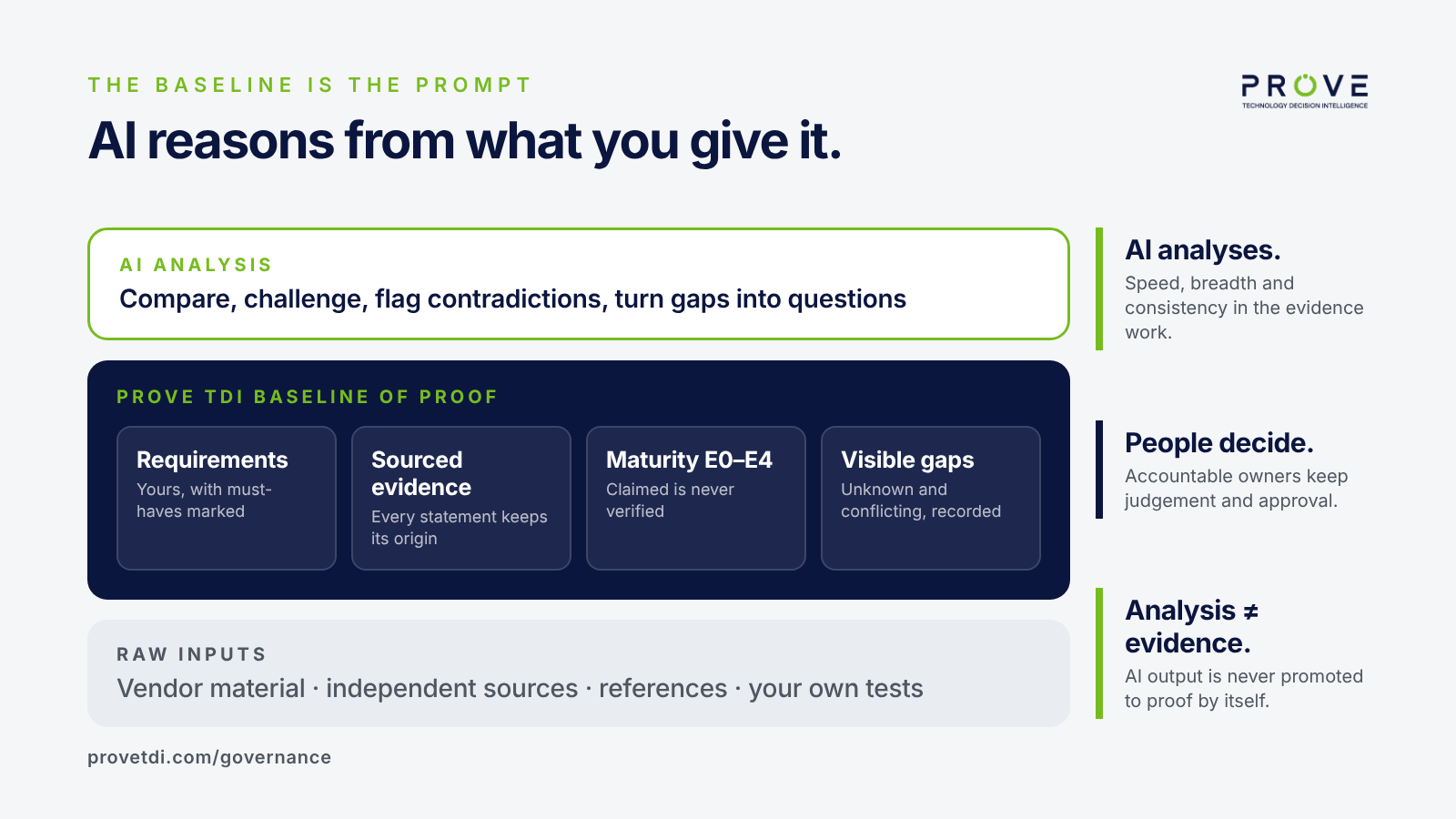
AI doesn't need more data to make better assumptions. It needs better-structured data. Four things make the difference.
1. Your requirements, in your words. What you need, with mandatory items marked. Without them, AI compares products with each other instead of with your situation, and the most feature-rich product tends to win by default.
2. Evidence with a source. Every statement linked to where it came from: a vendor document, an independent review, a reference call, a test your own team ran. A vendor claim then can't pass for a verified fact, because its origin travels with it.
3. A maturity level for each piece of evidence. Is a statement only captured, backed by a source, corroborated independently, validated, or confirmed by real outcomes? At PROVE TDI we grade this on an E0–E4 evidence maturity scale. With that in place, the AI can say "probably" when it should, and "confirmed" only when it can.
4. Gaps that are visible. "Unknown" and "conflicting evidence" recorded as answers in their own right. When a gap is written down, the AI reports it. When it isn't, the AI fills it.
Give AI that baseline and its role changes. It stops guessing and starts reasoning: comparing evidence, spotting contradictions, flagging what's missing, and turning gaps into the right questions. That's the work it's actually good at.
Analysis is not evidence
There's a subtler risk too. Once AI has produced an analysis, that analysis starts to look like evidence. It's well written, it's in the decision file, and three months later nobody remembers that it was a synthesis rather than a finding.
That's why we wrote a set of explicit boundaries into PROVE TDI's governance principles. A few of them matter most here:
- AI output is not proof by itself. AI-generated analysis is not automatically promoted to established evidence.
- Model confidence is not evidence confidence. How sure the model sounds says nothing about how strong the underlying proof is.
- Vendor material stays vendor material. Vendor-submitted information remains identifiable as vendor-controlled until it is independently corroborated, and vendors cannot buy a higher evidence level.
- Recommendation is not approval. AI can structure, compare, challenge and explain a decision. Accountable people approve it.
These aren't restrictions on AI. They're what makes its output trustworthy enough to act on.
Where PROVE TDI fits
This is the problem we built PROVE TDI to solve. It gives technology decisions a baseline of proof that people and AI can both work from. In practice, that baseline is the prompt.
A governed record of the decision. Requirements, alternatives, attributable evidence, assumptions, risks and approvals sit together in one Decision Ledger. Each piece of evidence keeps its source and its maturity level. Vendor claims stay labelled as claims. Gaps stay visible as gaps.
Market intelligence that starts from sources, not slogans. PROVE TDI Technology Intelligence covers more than 1,200 public technology vendor profiles for workplace, property and facilities teams, each built from attributable source records. That gives AI a starting point that is broader than the three vendors your team already knows, and more honest than their websites.
AI that works inside the structure. AI helps with research, comparison and quality checks. Every conclusion it reaches can be traced back to the evidence behind it, and where the evidence runs out, it says so. AI analyses; people decide.
An output you can defend. The result is a Proof Report: a clear account of the decision, backed by the ledger behind it. A polished PDF without provenance is still only presentation.
If you want to see how this works, the 5-minute interactive demo needs no account.
Five questions to ask before trusting an AI comparison
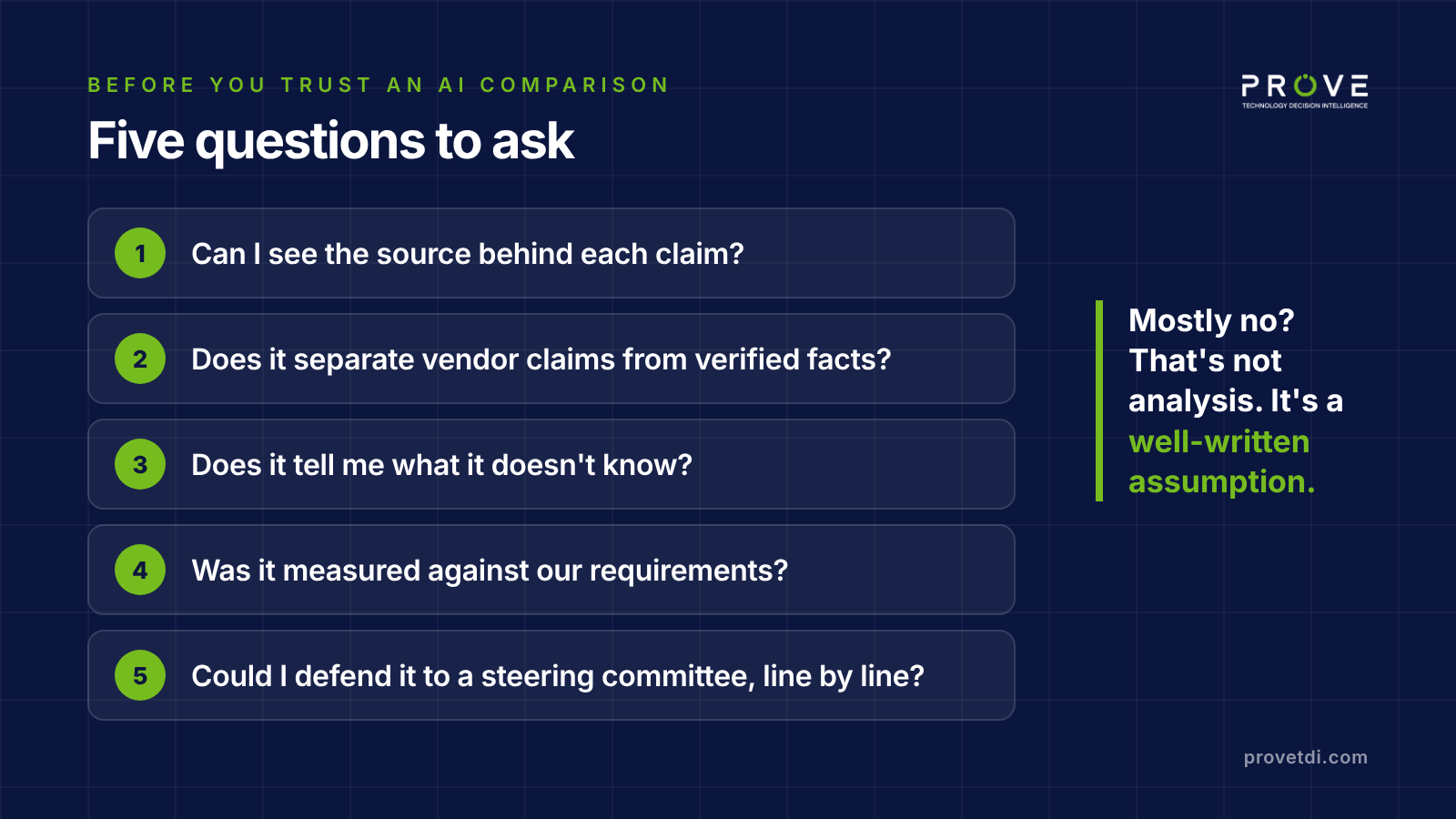
Whatever tools you use, these questions quickly show whether an AI-generated vendor comparison deserves your trust:
- Can I see the source behind each claim? If not, you can't check it, and neither can anyone who reviews the decision later.
- Does it separate what vendors say from what has been verified? If every statement reads the same, the difference has been lost.
- Does it tell me what it doesn't know? An answer with no gaps in it is a warning sign, not a strength.
- Was it measured against our requirements, or against the market in general? A product can be the best on the market and still the wrong fit for you.
- Could I explain this conclusion to a steering committee, line by line? If you'd have to say "the AI said so", you're not ready to decide.
If the answer to most of these is no, you don't have an analysis yet. You have a well-written assumption.
Less pitch. More proof.
AI will play a growing role in how organisations choose technology. That's a good thing. It can read more, compare faster and challenge assumptions people would rather not question.
But it will only reason from proof if we give it proof to reason from. Otherwise it reasons from whatever happens to be published most, and in enterprise software that's usually the pitch.
How is your organisation using AI in vendor evaluation today, and how do you check what it tells you?
Frederik Joustra is the founder of PROVE TDI, a technology decision intelligence platform for workplace, property and facilities teams.
Originally published on LinkedIn.