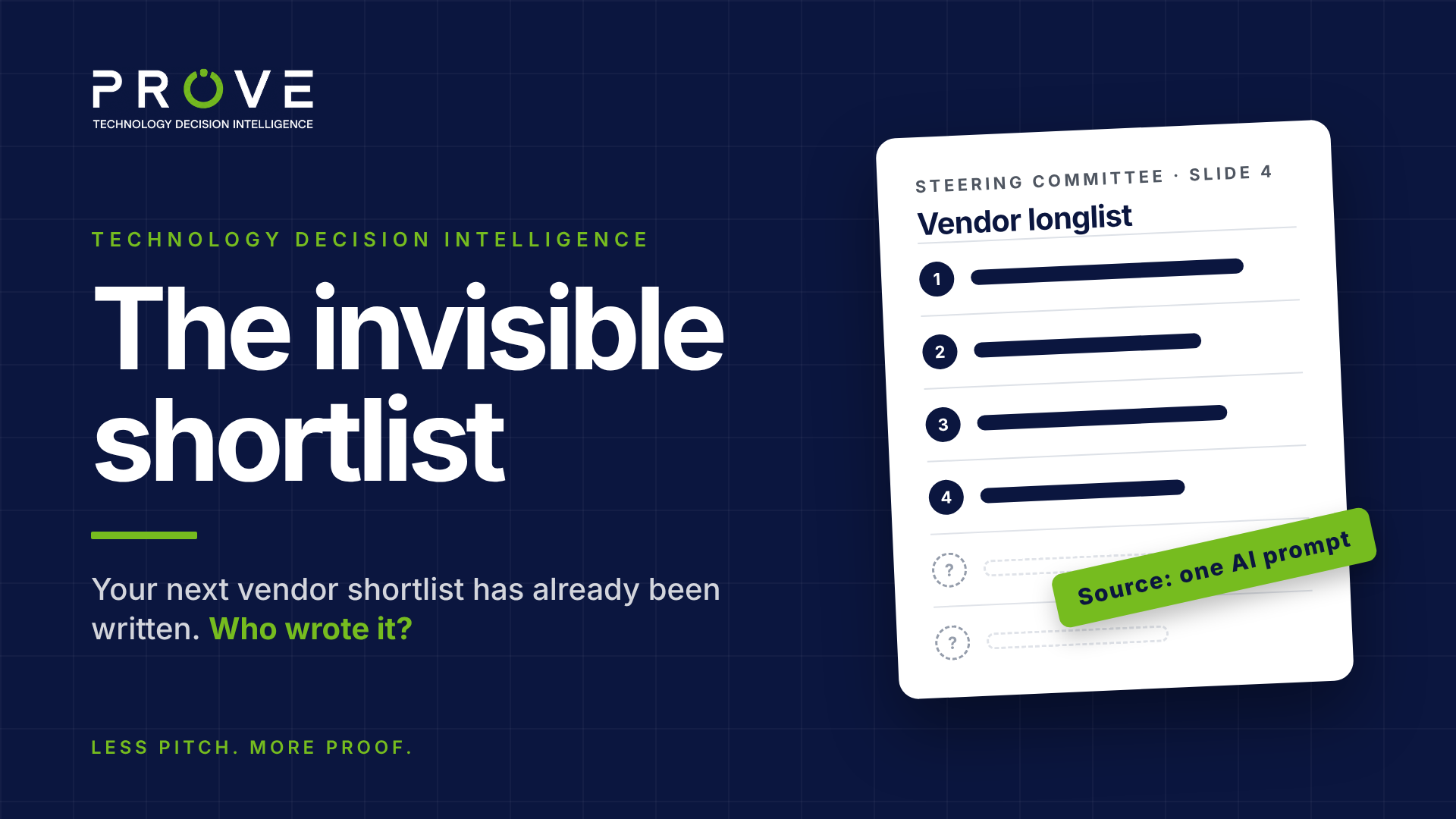
Your next vendor shortlist has already been written. You just haven't seen it yet.
It happens quietly, in a single question typed into a chat window. Here's who's really writing your shortlist, and how to take it back.
It's a Tuesday afternoon in late autumn. The budget for next year has just been approved, and somewhere in it is a line for a new workplace management platform. The current system is eight years old, the contract ends in eighteen months, and everyone agrees it's time.
The facilities director has a steering committee in two weeks. She needs something to show them. Not a decision, just a sense of the market: who the serious players are, roughly what they cost, what a realistic shortlist might look like.
So she does what most of us now do when we need to get our bearings fast. She opens an AI assistant and types one sentence: "What are the best workplace management platforms for a mid-sized European company with around 40 sites?"
Twenty seconds later she has an answer. Four vendors, each with a short paragraph. Strengths, typical customers, a note on pricing models. It's clear, well organised and, frankly, better than what she'd have pulled together in an afternoon of browsing.
She copies it into a slide. The slide goes into the steering committee pack. The committee nods. The four names become "the longlist", and later, after some trimming, "the shortlist".
Nobody in that room decided which vendors would be considered. Nobody decided which ones wouldn't. And yet, from that Tuesday on, the decision had a shape.
(This scenario is a composite, not a real client. But if you've been anywhere near a technology selection in the last year, it probably sounds familiar.)
It felt like research. It was a decision.
What happened on that Tuesday deserves a closer look, because it doesn't feel like anything important happened at all.
It felt like orientation. A quick scan to get started, the kind of thing you'd once have done with a search engine, an analyst report and a few phone calls. Harmless. Provisional. Easy to revisit later.
Except it rarely gets revisited. Once four names are on a slide in front of a steering committee, they stop being a rough first impression and become the frame for everything that follows. The RFP is written with those vendors in mind. The demos are booked with them. The scoring workshop compares them with each other. Months of careful, well-governed process then unfold inside a boundary that was drawn in twenty seconds, by a system nobody asked to draw it.
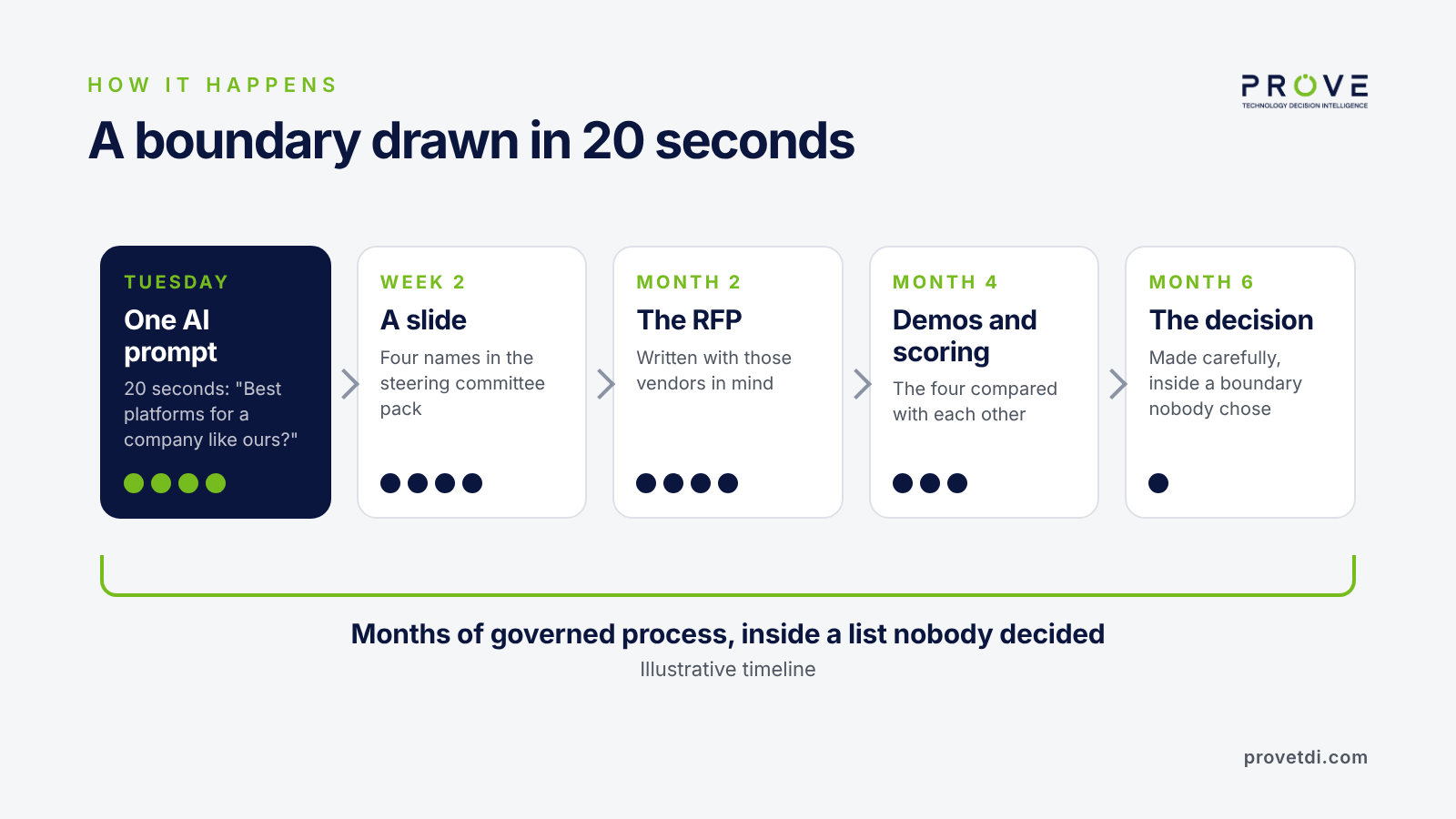
This isn't a fringe behaviour. When G2 surveyed more than a thousand B2B software buyers this spring, half said they now start their research in an AI chatbot more often than in a search engine. More telling still, seven in ten said they ended up with a different vendor than the one they first had in mind. The first answer on the screen is quietly becoming the first draft of the decision.
And the first draft matters more than we like to admit. Research on B2B buying has shown for years that most buyers settle on a favourite long before they speak to a single salesperson, and that the favourite usually wins. AI hasn't changed that pattern. It has just moved the moment of preference earlier, and made it much faster.
So the real question isn't whether AI is shaping your shortlist. It almost certainly is. The question is: what was the AI reading when it shaped it?
What I saw from the other side of the table
I spent years on the vendor side of enterprise software, selling workplace and facilities platforms across the Nordics, the Baltics and Poland. I'm not embarrassed by that. But it does mean I know exactly how the information that AI reads today gets made.
A vendor's public footprint is built with one purpose: to make the product look like the obvious choice. Product pages describe capabilities in their best light, and sometimes describe the roadmap as if it had already shipped. Case studies are chosen because the project went well, with the customer's permission and the marketing team's editing. Comparison articles are often written, or sponsored, by one of the vendors being compared. Press releases announce partnerships that sound like deep integrations but may amount to a logo exchange.
None of that is dishonest. It's marketing, and everyone in the industry understands the rules. A human buyer, especially an experienced one, reads it with a raised eyebrow. They know which claims to test in the demo and which reference customers to call.
An AI assistant doesn't raise an eyebrow. It reads all of that material, weighs it by how often and how confidently it appears, and returns a fluent summary in a neutral, helpful tone. The marketing doesn't disappear. It gets laundered. What went in as a pitch comes out sounding like analysis.
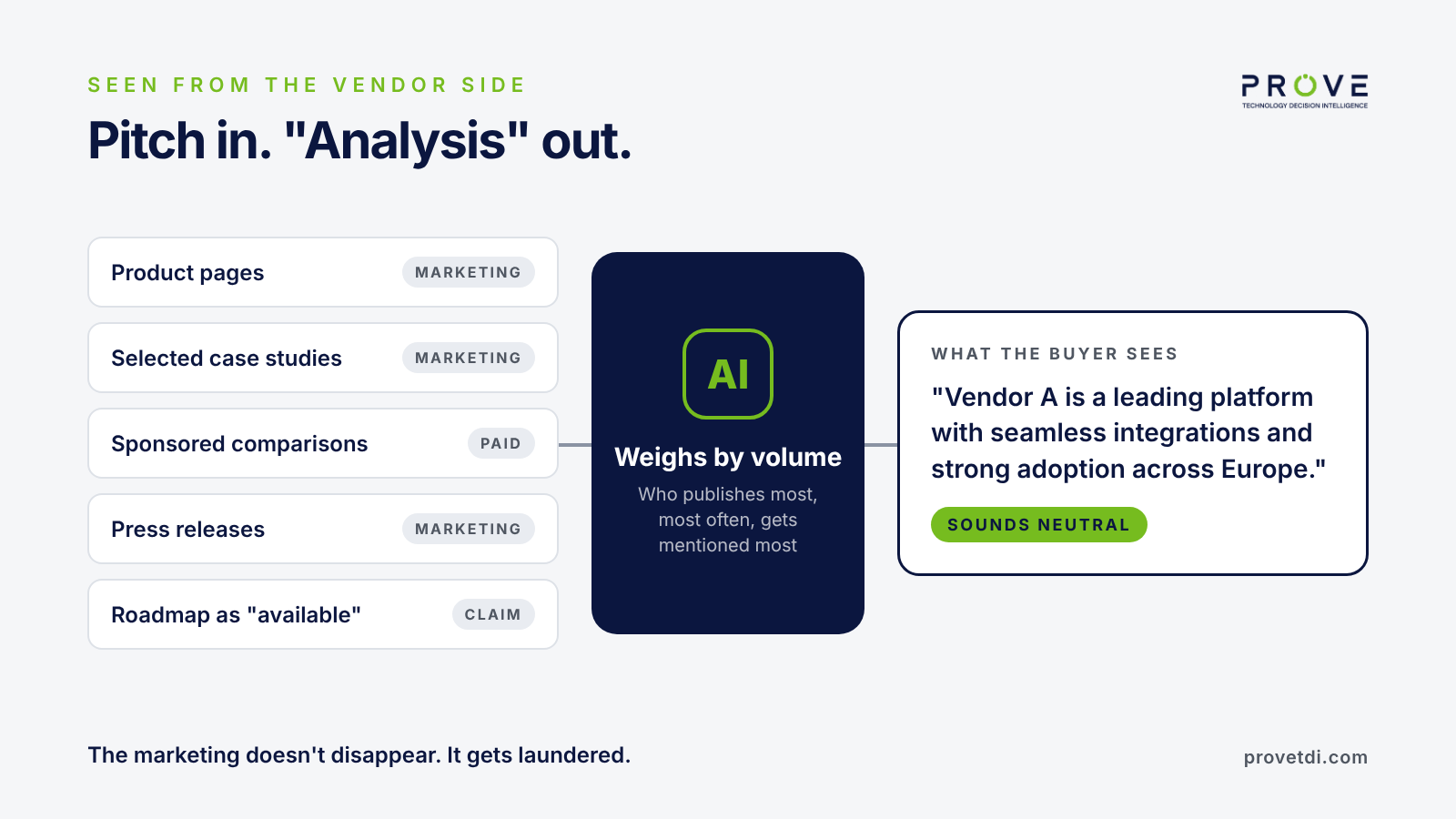
And the industry has noticed. A new discipline has grown up around getting brands mentioned in AI answers, sometimes called generative engine optimisation. It's a logical response: G2 found that most buyers think more highly of a vendor simply because an AI included it. If being named by the chatbot is the new first impression, vendors will compete for it.
Explainer: What is generative engine optimisation (GEO)? The practice of shaping a brand's public content so that AI assistants mention it, and describe it favourably, when people ask for recommendations. It's the AI-era successor to search engine optimisation. It rewards volume and consistency of publishing, not the strength of the evidence behind a product.
But look at what that competition rewards. Not the best product for your forty sites. Not the strongest evidence. It rewards whoever publishes the most, most consistently, in the places AI models read. The smaller specialist with a genuinely better fit, but a two-person marketing team, may simply never appear.
The facilities director's four vendors weren't wrong, necessarily. They were just the four with the loudest public footprint. And she had no way to tell the difference.
The cost arrives later, and quietly
If the selection goes reasonably well, nobody will ever think about that Tuesday again. That's what makes the invisible shortlist so hard to see. Its costs don't show up on the day. They show up years later, and they rarely get traced back.
Fast-forward three years. The platform is live. Some of it works well. The integration with the building management systems never quite did what the sales deck suggested, and the mobile app that was supposed to transform the help desk is used by a handful of technicians. Now the renewal is due, and the price is going up.
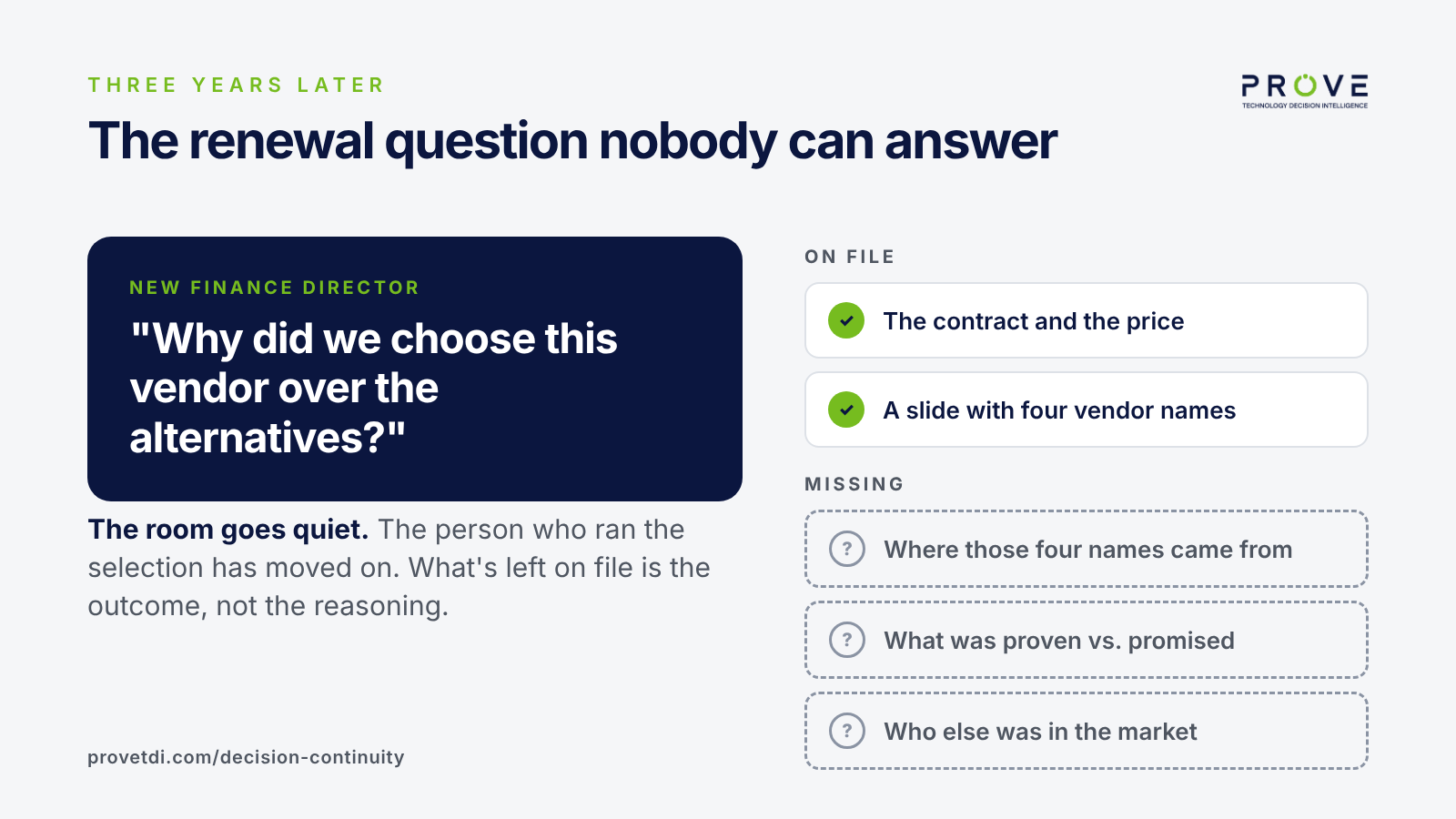
A new finance director, who wasn't there for the original decision, asks a simple question in the meeting: why did we choose this vendor over the alternatives?
The room goes quiet. The facilities director has since moved on. The scoring spreadsheet is somewhere on a shared drive. The steering committee pack shows four vendors on a slide, with no record of how those four were chosen, or of who else was in the market at the time.
This is where the invisible shortlist turns into a real problem. Without the reasoning, the organisation can't negotiate from strength, because it can't hold the vendor to promises nobody wrote down. It can't judge whether the platform delivered, because nobody recorded what it was supposed to deliver. And it can't say with any confidence whether a better option existed, because the market it compared against was never really the market. It was four names in a chat window.
So, as often as not, the evaluation starts again from scratch. And this time, someone opens an AI assistant and types one sentence.
Taking the shortlist back
The answer is not to ban AI from the process. That ship has sailed, and frankly it shouldn't be called back. Used well, AI is extraordinary at the slow, tedious parts of an evaluation: reading documentation, comparing capabilities, spotting contradictions, drafting the questions you should be asking.
The problem on that Tuesday wasn't the AI. It was the order of things. The question came before the requirements, and the answer came from the pitch.
Imagine the same afternoon, done differently.
The facilities director starts by writing down what her organisation actually needs: forty sites, an integration with the existing building systems, EU data residency, a help desk that technicians will genuinely use. Before any vendor is named, she knows which of those are non-negotiable.
Then, instead of asking a chatbot for four names, she starts from a view of the whole market, built from sources rather than slogans. Not four vendors, but every vendor that could plausibly fit, each with a record of where its information comes from.
Now AI earns its keep. It compares that wider market against her requirements. Where a capability is proven, it says so. Where it's only claimed by the vendor, it says that too. Where nothing is known, it doesn't guess. It writes the question for the RFP instead.
Explainer: Evidence maturity Not every statement about a product deserves the same trust. PROVE TDI grades evidence on an E0–E4 scale, from information that is only captured, through source-backed and independently corroborated, up to validated and confirmed by real-world outcomes. Vendor-submitted material stays labelled as vendor material until something independent backs it up, and no vendor can pay for a higher level.
The shortlist she takes to her steering committee might include the same four names. It might not. Either way, she can explain exactly how it was built. And three years later, when a new finance director asks why, the answer is there, waiting.
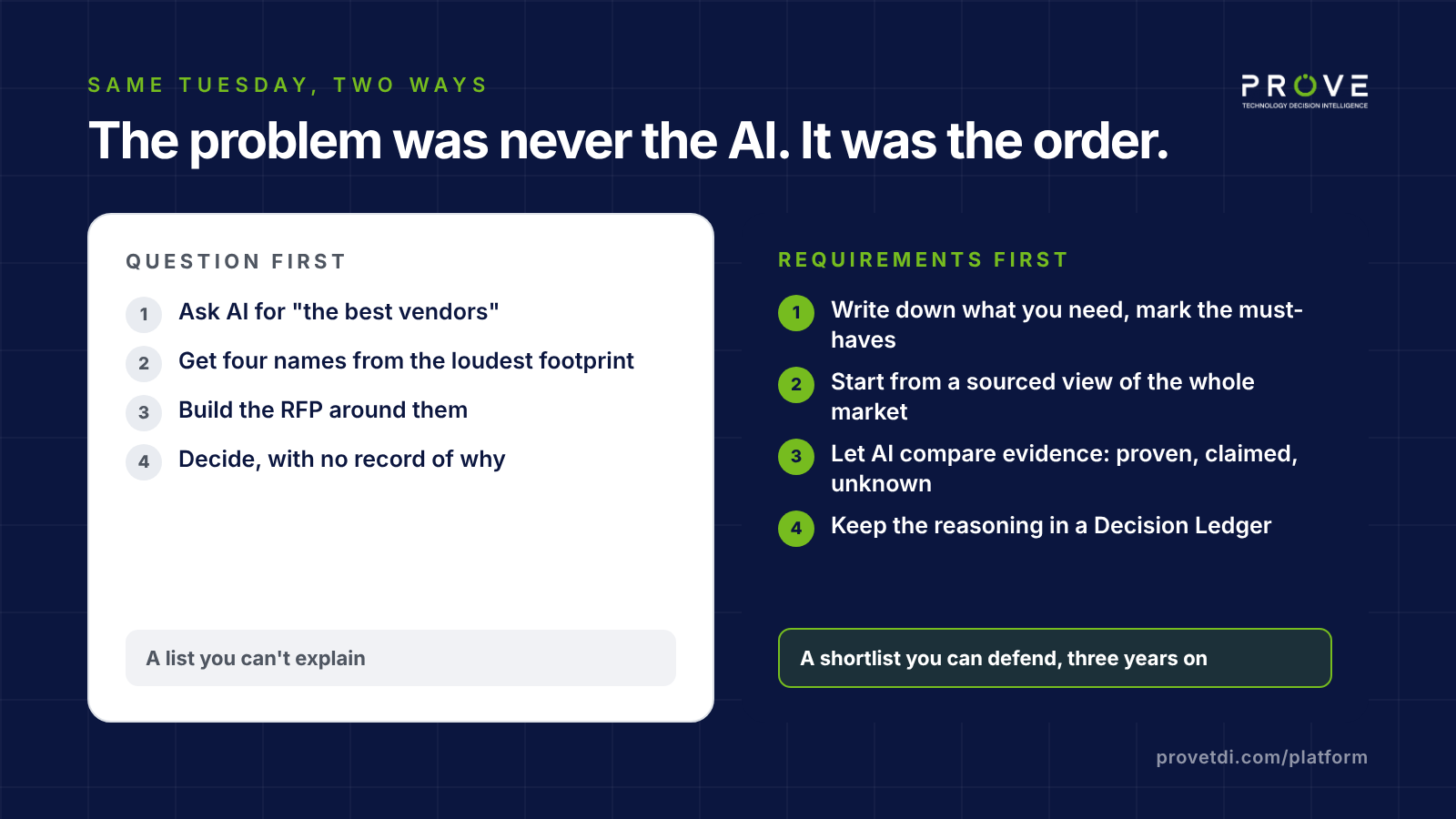
That's the work we built PROVE TDI to support. It gives technology decisions in workplace, property and facilities a baseline of proof: requirements first, a sourced view of the market, evidence that keeps its origin and its level of confidence, and a Decision Ledger that holds the reasoning long after the project team has moved on. AI does the heavy lifting inside that structure. People keep the judgement and the authority.
Explainer: What is a Decision Ledger? A governed record of a technology decision. It connects the requirements, the alternatives that were considered, the evidence and its sources, the assumptions and risks, and who approved what and when. The Proof Report is what you hand to a steering committee; the ledger behind it is what lets someone answer "why did we choose this?" three years later. More on that idea in decision continuity.
There's something in this for vendors too, and it matters to me personally after my years on that side. When buyers evaluate on evidence rather than on visibility, a strong product no longer needs the loudest marketing budget to be considered. It just needs to be able to show what it does.
The question worth asking this week
Most organisations are now in the middle of next year's planning. Budgets are being approved, contracts are being reviewed, and somewhere in your organisation a line item for new technology is about to turn into a project.
Which means that, very soon, someone will open a chat window and type one sentence. It might be you.
Before they do, it's worth pausing on a simple question. Think about the last technology shortlist your organisation built, the one that's now running in production.
Do you know where those names came from?
If you'd like to see what a shortlist built on proof looks like, the 5-minute interactive demo needs no account.
Frederik Joustra is the founder of PROVE TDI, a technology decision intelligence platform for workplace, property and facilities teams.
Sources
Originally published on LinkedIn.